Master of Social Work
Master of Social Work mission statement
The mission of the MSW program is to prepare students for advanced social work practice that addresses complex human needs through interpersonal practice or knowledge and skills in community, policy, and leadership. The MSW program creates a collaborative and diverse partnership between faculty, staff, students, and the larger social work community to utilize evidence-informed practices to address and advance human rights and social, economic, and environmental justice, with a particular focus on urban communities. Informed by a person-in-environment framework, a global perspective, and respect for human diversity, the MSW program produces community-engaged, anti-racist, and anti-oppressive social work practitioners who are guided by core social work values of service, social justice, dignity and worth of the person, importance of human relationships, integrity, competence, human rights, and scientific inquiry.


Highlights
-
We are accepting MSW Program applications from September 16 to May 1
Master of social work degree options
Become a world-class social work practitioner through the two-year Master of Social Work program at Wayne State University. Study on-campus or online via Michigan's first fully asynchronous program (Interprofessional concentration only) and prepare for LLMSW or LMSW licensure upon graduation.
We're rated among the best MSW programs in the nation: WSU is in the top 50 Schools for Social Work 2024 according to the U.S. News & World Report. That excellence is evident in our commitment to social and economic justice, assisting vulnerable and oppressed individuals, and improving the lives of individuals, families, groups, and communities.
Learning outcomes
Combine community engagement, research, and theory to actively participate in the populations you serve. The master's degree in social work at Wayne State prepares you to uphold the core values of social work with professional competence and passionate dedication to the individuals, families, groups, and communities you support.
Through immersive student internship experience in your desired area of practice, you'll apply classroom knowledge and invoke community action. The MSW program prepares you for LLMSW or LMSW licensure along with further credentials such as graduate certificates or a dual degree. Here, you'll establish a professional foundation that empowers you to:
- Pursue justice for communities facing social and structural inequity
- Advocate for environmental justice
- Lead as an eager and compassionate social worker
- Advance policies that serve individuals, families, groups, and communities
- Research impactful social work data and narratives
- Collaborate with care teams, communities, and colleagues
Requirements and curriculum
As an MSW Core student, you'll complete a total of 60 graduate credits. If you qualify for Advanced Standing credit, you'll take 36 graduate credits in the Master of Social Work program. You'll need to maintain an overall GPA of at least 3.0 in all MSW courses.
You'll also apply your learning hands-on with at least 450 practicum education clock hours. Between your practicum learning and your coursework, you'll demonstrate social work values and ethics as articulated in the Code of Ethics from the National Association of Social Workers.
Core is for students who have a non-social work undergraduate degree and Advanced Standing is for students who have earned a BSW degree within the last 5 years from a CSWE accredited school.
Courses
The MSW degree curriculum combines foundation (core) classes with advanced courses in one of two concentrations: Interpersonal Practice or Innovation in Community, Policy and Leadership. You may choose the concentration that best fits your career goals. Your course load will also vary depending on your enrollment as a CORE student or with Advanced Standing.
- CORE: The foundation (core) curriculum provides a knowledge base for later study of advanced practice in the concentration. The core curriculum has content in the five major curricular areas: social work practice, human behavior and the social environment, social welfare policy and services, research, and practicum education. The core curriculum stresses fundamentals and knowledge of social work practice as they relate to individuals, families, small groups, organizations, and communities. During the foundation (core) year, students declare their interest in an advanced curriculum concentration. Students must complete the core curriculum (32 credits) before enrolling in advanced curriculum courses.
- ADVANCED STANDING: Students admitted with advanced standing are required to complete six graduate credits toward the MSW degree during the summer term following admission but before enrolling in courses in the advanced curriculum, and subsequently an additional 30 credits in the advanced curriculum of the graduate program, as prescribed within the student's concentration (total 36 credits).
Student internships
Hands-on learning equips you to become a competent and well-prepared social worker. The MSW student internship education component focuses on social service agencies working in urban areas and supporting diverse at-risk populations. Your placement may serve individuals, families, groups, organizations, or communities, and you'll gain practice addressing personal, interpersonal, and social problems.
In your foundation year (for CORE students), you'll complete 16 internship hours per week totaling 450 clock hours. Once you're studying within your concentration, you may continue doing 16 weekly internship hours, or you may choose the "three-day placement" (24 hours per week) option in place of some elective credits. Your advanced internship education year will involve 450676 clock hours.
Dual degrees, certifications, and additional courses
Build on your concentration in one of seven focal areas, or enhance your master's degree in social work with a dual-title degree in Social Work and Infant Mental Health or a joint degree in Social Work and Public Health. These specializations hone your focus and equip you with knowledge and skills pertaining to a particular practice area or client population.
The School of Social Work also offers non-degree options, which you can add on to your MSW degree or complete separately. Fulfill career advancement requirements in the Holistic Defense or Temporary Approval for Michigan School Social Workers course series, or earn a graduate certificate:
- Certificate in Alcohol and Drug Use Studies (CADUS)
- Child Welfare Certificate
- Developmental Disabilities Certificate
- Gerontology Certificate
Earn an MSW degree at your own pace
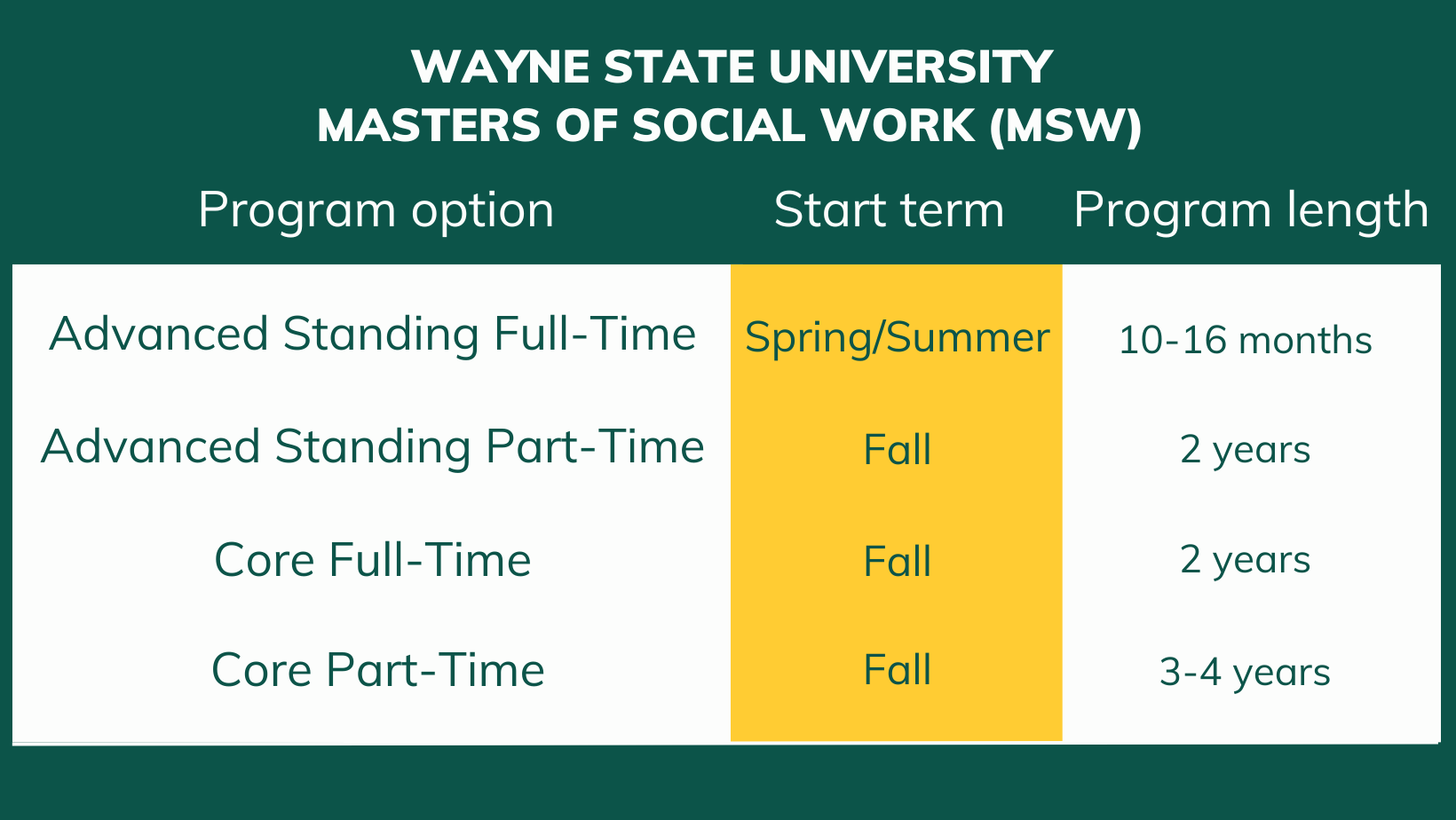
Take advantage of WSU's flexible program options. Earn your Master of Social Work degree in two years as a full-time student or three to four years as a part-time student and choose from programs that fit your schedule offering day, evening, in-person and online classes.
Apart from your practicum education requirement, you can complete the MSW program fully online, in-person and online courses, or fully on-campus at WSU's main Detroit location.
Accelerated Master's Pathway (AMP) option
If you're pursuing your Bachelor degree at Wayne State, you may be able to fast-track your MSW studies through the Accelerated Master’s Pathway (AMP) program option. You'll select up to 15 credits of social work graduate-level courses in human behavior, research, and policy which are required for the MSW Core program and you'll still pay undergraduate tuition, meaning you can save both time and money.
BSW students who meet GPA requirements may apply for the AMP for BSW students option and may take select elective courses in their last semester of the BSW program which will count toward the MSW Advanced Standing program when students are admitted - and pay undergraduate tuition.
World-class accredited MSW program
The Wayne State University School of Social Work, Master of Social Work program is fully accredited by the Council on Social Work Education (CSWE). WSU M.S.W. program assessment of Student Learning Outcomes - form AS-4 (M)
Federal regulations require Wayne State University (WSU) to publicly disclose, for each educational program designed to meet the educational requirements for a specific professional license or certification required for employment in an occupation (or advertised as meeting those requirements), information about whether program completion would meet those requirements in a state. View the disclosure here.
MSW career opportunities
You may be among the many students asking, "What can I do with a master's in social work?" At WSU, you'll encounter the possibilities firsthand through practicum education, close relationships with your professors and mentors, and resources in our Career Services office.
Social work is a rapidly growing field, per the Bureau of Labor Statistics, and social workers earn above-average salaries. The median annual salary for all social workers is $50,390; those with MSW and full licensure credentials tend to earn more than BSW holders. An MSW is required for clinical social work roles, and you can also work in fields like:
- Advocacy and community organizing
- Health care
- Mental health care
- Child welfare
- Public welfare
- Justice and corrections
- Policy and planning
- Research
- Social work administration
Admission requirements (no GRE required)
To pursue an MSW degree at Wayne State, you need to hold a baccalaureate degree from an accredited institution and have earned a minimum undergraduate GPA of 2.75. You'll also need at least 30 credits in the social and biological sciences and the humanities. You'll apply for either CORE or Advanced Standing placement in the MSW program.
Apply for CORE (fall term start) if you hold an undergraduate degree in a field other than social work OR if you completed your BSW more than five years ago.
Apply for Advanced Standing (spring/summer term start) if you earned a BSW from a Council of Social Work Educationaccredited program within the last five years.
To apply, you will include your official transcripts, resume, two references, and a statement of purpose detailing your passion for positively influencing individuals, families, and communities as a social worker.
Affording your MSW degree - tuition and financial aid
Earn your master's degree in social work from Wayne State University and pay affordable MSW tuition. Our MSW program aims to be accessible to as many learners as possible, demonstrating our key values of diversity and economic justice.
If you're completing your Bachelor degree in the College of Liberal Arts and Sciences or BSW at Wayne State, take advantage of the tuition savings available through the Accelerated Master’s Pathway (AMP) program option. You can also apply for social work scholarships and additional financial aid opportunities.
Advocate for social justice with an MSW degree
The flexible on-campus or online MSW degree from Wayne State University is one of the best MSW programs in Michigan and in the country. It equips you to support and empower individuals, families, groups, and communities.
Here, you'll establish practicum experience and knowledge that can contribute to your full social work licensure and other career advancements. Request information to learn more about Wayne State's Master of Social Work degree program, or apply today!
Contact
Andre Iadipaolo, MSW
Prospective Student Advisor
andre.iadipaolo@wayne.edu
Schedule an appointment with Andre
Lisa O'Donnell, PhD
MSW Director and Assistant Professor
lisa.o.donnell@wayne.edu